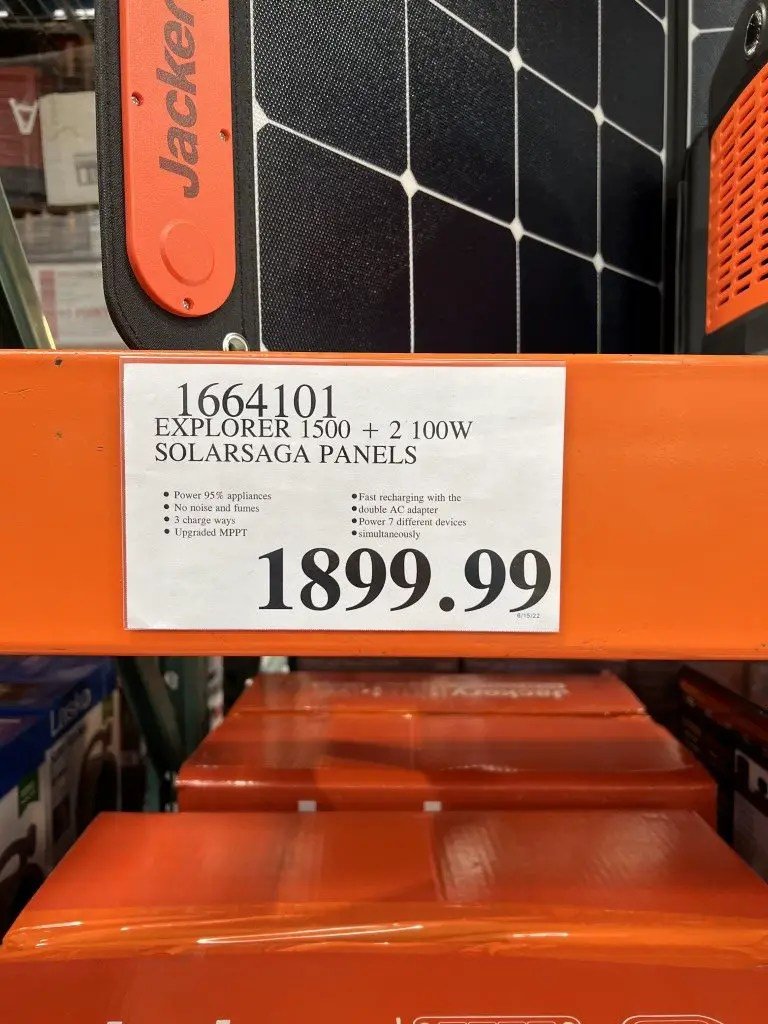
You've likely strolled the wide aisles of Costco, marveling at everything from bulk groceries to towering electronics. So when you spot a solar generator — a device promising clean, silent power for emergencies, camping, or off-grid living — it's natural for your ears to perk up. "Solar power at Costco? That must be a deal!" you might think. And you wouldn't be entirely wrong.
Costco, with its legendary customer service and member benefits, has indeed entered the solar generator market. But as with any specialized technology sold by a general retailer, choosing a solar generator at Costco requires a savvy approach. This isn't just about grabbing the biggest box; it's about understanding what you're buying, what you're not getting, and whether it truly aligns with your specific power needs. Let's break down how to navigate this unique landscape.
At a Glance: Solar Generators at Costco
- Pros: Potentially competitive prices, easy returns, in-person viewing (if stocked locally), 2% cashback with Costco credit card.
- Cons: Limited product selection, frequent stock issues, staff lack solar expertise, dated models common, no custom kits, no manufacturer-level support, basic solar panels (Grape Solar) often bundled.
- Best for: Entry-level users, those with simple power needs, or anyone comfortable with self-service and manufacturer direct support.
- Consider Alternatives if: You need complex systems, expert advice, comprehensive kits, long-term support, or cutting-edge technology.
- Key Decision Points: Understand your power requirements (Watt-hours for capacity, Watts for output), battery chemistry, and charging options before looking at specific units.
The Allure of Costco: Why It Catches Your Eye
It's undeniable. Costco holds a powerful draw. When you see a high-tech item like a solar generator there, several benefits immediately come to mind:
- Competitive Pricing: Costco is known for leveraging its bulk purchasing power. This often translates to prices that can be 10-20% lower than standalone retailers, according to some reports. For expensive equipment, those savings can be significant.
- Hassle-Free Returns: The legendary Costco return policy is a huge comfort. If you buy a complex piece of equipment and it doesn't meet your expectations or has an issue, the process for returns is generally straightforward, reducing buyer risk.
- In-Person Shopping: With hundreds of warehouses across the US, you might have the option to physically see the product. This can be invaluable for understanding its size, weight, and build quality, which photos online can't always convey.
- Member Perks: If you're a Costco credit card holder, that additional 2% cashback on purchases can sweeten the deal further.
These advantages make Costco an attractive first stop, especially for those new to solar power. But it's crucial to look beyond the immediate benefits and understand the specific context of buying specialized solar equipment from a general retailer.
The Practical Realities: Where Costco's Approach Differs
While the allure of Costco is strong, the world of solar generators is specialized. When you venture into this territory with a big-box store, you encounter some unique considerations that might not be immediately apparent:
Limited Product Selection & Availability
Unlike a specialized solar retailer, Costco's inventory of solar generators is quite narrow. You'll likely find only a handful of models, such as the EcoFlow Delta PRO, EcoFlow River PRO, Jackery Solar Generator 3000 Pro, and Bluetti AC500 + B300S. The Lion Energy Safari ME has also made appearances. What’s more, these items are frequently out of stock, temporarily removed from the website, or not available in all warehouses. This scarcity can make it difficult to compare options directly or get the exact unit you need when you need it.
A Knowledge Gap Among Staff
Imagine asking a question about maximum input wattage or battery cycle life to someone in the electronics aisle. While Costco staff are fantastic for general customer service, they typically possess minimal to no knowledge regarding the technical specifications, setup, or specific use cases for solar generators and related equipment. This means you'll largely be on your own for research and decision-making.
Dated Technology and Basic Panel Bundles
The rapid pace of innovation in portable power stations means that some units available at Costco can quickly become dated. While models like the EcoFlow Delta PRO and Jackery 3000 Pro are exceptions, offering substantial power and modern features, others may lag.
Furthermore, solar panel kits bundled with generators often exclusively feature Grape Solar panels. These are generally considered mid to low range in efficiency and performance. They are a basic option suitable for entry-level systems or tight budgets, but not ideal if you're looking for high efficiency, durability, or long-term performance from your solar array. These bundles rarely offer custom wiring diagrams or setup instructions beyond generic manufacturer guides.
The Manufacturer is Your Main Support System
Costco excels at selling and returning products, but they don't offer follow-up customer service for technical solar issues. If you have questions about installation, performance, troubleshooting, or defects, you'll be directed to the manufacturer. This isn't inherently bad, but it means you won't have a single point of contact for your entire purchase and post-purchase experience.
No Guarantee of Future Stock
Costco's product line is ever-changing. There's no guarantee that a specific solar generator model or type of solar panel will continue to be stocked. This could complicate future plans for expansion (e.g., buying more of the same panels) or even exchanges if a replacement isn't available.
What to Look for in Any Solar Generator: Your Buying Blueprint
Before you even step foot in a Costco (or browse online), arm yourself with knowledge about what makes a good solar generator. This "buying blueprint" will help you assess any unit, regardless of where it's sold.
1. Power Output (Watts - W): What Can It Run?
This is about the instantaneous power a generator can deliver. Think of it like the horsepower of your car – how much muscle it has at any given moment.
- Continuous Wattage: The power it can deliver constantly. A microwave or hairdryer might need 1500W-2000W. A small fridge typically uses 100-250W.
- Peak/Surge Wattage: A brief burst of higher power for motors starting up. This is crucial for appliances with induction motors (refrigerators, power tools).
Your Action: List all the appliances you plan to power simultaneously. Check their wattage requirements (usually on a sticker). Add them up. Don't forget surge requirements! Aim for a solar generator with a continuous output slightly higher than your total simultaneous wattage, and a surge rating that can handle your most demanding appliance's startup.
2. Battery Capacity (Watt-hours - Wh): How Long Can It Run?
This is the "fuel tank" size – how much energy the generator can store.
- Understanding Wh: A 1000Wh battery can power a 100W appliance for 10 hours (1000Wh / 100W = 10 hours).
- Common Needs:
- Small (200-500Wh): Charging phones, laptops, drone batteries, small lights for a day or two. (e.g., EcoFlow River PRO, Jackery Explorer 500)
- Medium (500-1500Wh): Running a mini-fridge, CPAP machine overnight, lights, and multiple devices for a couple of days. (e.g., Jackery Explorer 1000, Bluetti AC200P)
- Large (1500Wh+): Home backup for essential appliances, extended camping, RV living, powering a full-size fridge, TV, etc. (e.g., EcoFlow Delta PRO, Jackery 3000 Pro, Bluetti AC500)
Your Action: Estimate the total Watt-hours your essential devices will consume over the period you need backup power. Factor in daily usage. A general rule of thumb: divide your daily Wh need by 0.85 (to account for inverter inefficiencies) to get the required battery capacity.
3. Battery Chemistry: Longevity and Safety
Most modern solar generators use Lithium-ion (Li-ion) batteries, but there are important distinctions:
- NMC (Nickel Manganese Cobalt): Common, good energy density (smaller/lighter), but shorter cycle life (500-800 cycles to 80% capacity).
- LiFePO4 (Lithium Iron Phosphate): Becoming the gold standard for solar generators. Heavier/larger for the same capacity, but much longer cycle life (2500-3500+ cycles to 80% capacity), more stable, and safer. This translates to many years of reliable use.
Your Action: For frequent use or long-term investment, prioritize LiFePO4 batteries. For occasional use where portability is key, NMC might be acceptable.
4. Charging Speed & Inputs: Getting Juiced Up
How quickly can you recharge the unit, and what are your options?
- AC Wall Charging: Look for fast charging (e.g., 0-80% in 1-2 hours).
- Solar Input (Max Watts): The higher the max solar input, the faster you can recharge with solar panels. Match this to the panels you'll use.
- Car Charging: Useful for on-the-go.
- Expandability: Can you add extra batteries for more capacity?
Your Action: Consider your primary charging method. If solar is key, ensure the max solar input is high enough for efficient charging.
5. Port Selection & Features
- AC Outlets: How many, and what type (pure sine wave is essential for sensitive electronics)?
- USB Ports: USB-A, USB-C (preferably Power Delivery for fast charging laptops/phones).
- DC Ports: Car ports, 12V outputs for specific appliances.
- Connectivity: Wi-Fi/Bluetooth for app control (e.g., EcoFlow, Jackery).
- UPS Functionality: Can it act as an uninterruptible power supply for critical devices during a power outage?
Your Action: Ensure the generator has the right mix and number of ports for your devices. App control can be a huge convenience.
Costco's Current (and Past) Lineup: A Closer Look
With our blueprint in hand, let's look at some specific models you might encounter at Costco. Remember that availability is highly variable.
EcoFlow Delta PRO + Solar Panel Bundle
- Capacity: 3600Wh (expandable up to 25kWh with Smart Extra Batteries).
- Output: 3600W continuous, 7200W surge. Can power almost any home appliance.
- Battery Chemistry: LiFePO4 – excellent for longevity.
- Charging: Ultra-fast AC charging, high solar input.
- Key Features: Smart app control, UPS functionality, X-Boost technology (can power higher wattage devices by reducing voltage).
- Consideration: This is a high-end unit. The bundled solar panels need to be robust enough to match its charging capability.
Jackery Solar Generator 3000 Pro
- Capacity: 3024Wh (expandable with external batteries).
- Output: 3000W continuous, 6000W surge.
- Battery Chemistry: Likely LiFePO4 (Jackery has been moving towards this for Pro models).
- Charging: Ultra-fast solar charging (0-80% in 2 hours with sufficient panels), fast AC charging.
- Key Features: Quiet operation, app control, robust build.
- Consideration: A strong contender for RVs and home backup. Ensure the included panels maximize its fast solar charging capabilities.
Bluetti AC500 + B300S (Often Bundled)
- Capacity: 5120Wh with two B300S expansion batteries (AC500 is modular).
- Output: 5000W continuous, 10,000W surge. This is serious power for heavy appliances.
- Battery Chemistry: LiFePO4 – top-tier for cycle life.
- Charging: Fast AC and solar charging.
- Key Features: Modular design, app control, capable of powering entire circuits with additional accessories (not typically included at Costco).
- Consideration: This is an industrial-strength solution. If you need this level of power, understanding its modularity and potential for integrating into a home system is key, which may require outside expertise.
EcoFlow River PRO
- Capacity: 720Wh (expandable with an extra battery).
- Output: 600W continuous, 1200W surge (with X-Boost enabled).
- Battery Chemistry: Likely NMC (check specs, EcoFlow uses both).
- Charging: Fast AC charging, decent solar input.
- Key Features: Highly portable, good for smaller needs.
- Consideration: More suited for light camping, car camping, or charging smaller devices. Not for heavy home backup.
Lion Energy Safari ME
- Capacity: 922Wh.
- Output: 2000W continuous, 4000W surge.
- Battery Chemistry: LiFePO4 – a good choice for longevity.
- Charging: Moderate AC and solar charging speeds.
- Key Features: Lightweight, can be expanded with additional batteries.
- Consideration: A decent mid-range option, but often bundled with only 100W Lion Energy solar panels, which is a very limited amount of power for a 922Wh capacity battery. You'd need significantly more solar input for efficient charging.
Evaluating the Panels: The Grape Solar Question
Costco's solar panel kits, particularly those bundled with generators or sold separately, often use Grape Solar panels. While these panels are functional, they generally fall into the mid-to-low efficiency range.
- Efficiency: Lower efficiency means you need more physical space to generate the same amount of power compared to higher-efficiency monocrystalline panels.
- Performance: They are a basic, entry-level option, suitable for tight budgets or simple systems where space isn't a premium and maximizing power output isn't critical.
- Not for Long-Term, High-Performance Systems: If you're building a robust, long-term solar setup or need to squeeze every watt out of a limited area (like an RV rooftop), you'd likely want to invest in higher-quality, more efficient panels.
Your Action: If a solar generator bundle includes Grape Solar panels, understand their limitations. You might consider purchasing a higher-quality portable or flexible solar panel array separately from a specialized dealer if you need better performance or faster charging.
When Costco Shines (and When It Doesn't)
Having understood the general principles and specific Costco offerings, let's distill when Costco is a smart choice for your solar generator purchase.
Costco Might Be Right For You If:
- You're an Entry-Level User with Simple Needs: You need a basic setup for occasional camping, tailgating, or charging small devices during brief power outages. You're comfortable with a plug-and-play solution.
- You Prioritize Initial Cost Savings: If getting the lowest upfront Costco solar generator prices is your primary driver and you're willing to handle potential support directly with the manufacturer.
- You Appreciate the Return Policy: The peace of mind from Costco's generous return policy is important to you.
- You're Comfortable Being Self-Sufficient: You're happy to do your own research, understand the technical specifications, and troubleshoot issues without in-store expert assistance.
- You Only Need the Generator, Not an Integrated System: You're not looking to integrate it into a home energy system or require complex wiring diagrams.
When to Look Beyond the Big Box Store:
- You Need Expert Guidance: For complex setups, whole-home backup, or if you're new to solar and need someone to walk you through the options, answer technical questions, and help you size a system.
- You Require a Custom or Comprehensive Kit: Costco rarely offers custom kits that include all the necessary components (panels, cables, connectors, specialized mounting) tailored to your specific use case. Specialized retailers, like ShopSolarKits.com, are known for bundling comprehensive kits, often with higher-quality panels and all required accessories.
- You Value Post-Sale Support and Warranties: Specialized retailers often provide ongoing customer support, setup instructions, wiring diagrams, and assist with warranty claims, acting as your advocate.
- You Seek a Wider Selection and Cutting-Edge Technology: Specialist stores have a much larger product catalog, offering more choices for generators, panels, and accessories, including the latest innovations.
- You're Planning a Long-Term, Integrated Solution: For RV permanent installations, cabin off-grid systems, or home integration, the lack of knowledgeable staff, custom solutions, and dedicated support at Costco becomes a significant drawback.
Common Questions & Misconceptions
"Are Costco solar generators good value?"
Potentially, yes, for the raw unit price. However, "value" is subjective. If you need specialized support, more efficient panels, or a comprehensive kit, the perceived savings might be offset by the need to purchase additional components or expertise elsewhere.
"Can a Costco solar generator power my whole home?"
The larger units like the EcoFlow Delta PRO or Bluetti AC500 can power many essential home appliances, even a fridge, microwave, or a few lights and electronics simultaneously. However, powering an entire home (including central AC, electric dryer, electric stove) without careful energy management and potentially multiple interconnected units is generally beyond the scope of a single portable solar generator, regardless of where it's bought. For true whole-home backup, a home battery system or a more elaborate solar array is usually required.
"Do I need special installation for a solar generator from Costco?"
For plug-and-play portable use, no special installation is needed beyond plugging in panels and appliances. However, if you want to integrate it into your home's electrical panel (e.g., via a transfer switch), you will need a qualified electrician. Costco does not provide guidance or support for such installations.
"What about the warranty?"
The warranty comes from the manufacturer (e.g., EcoFlow, Jackery, Bluetti), not Costco. While Costco's return policy is excellent for initial defects or dissatisfaction, long-term warranty claims will be handled directly by the brand, which is standard across all retailers.
Making Your Smart Choice
Choosing a solar generator, whether at Costco or elsewhere, comes down to clarity on your needs and a realistic assessment of what each retail channel offers.
- Define Your Needs: Create that "buying blueprint" we discussed. What appliances? How long? What's your budget?
- Check Costco's Current Inventory: Browse their website or visit a local warehouse. Note the specific models and any bundled panels.
- Compare Specs: Cross-reference the Costco offerings with your needs. Pay close attention to power output, battery capacity, battery chemistry, and solar input.
- Evaluate the "Total Package": Consider not just the price, but also the quality of bundled panels, the need for additional accessories, and where you'll get support.
- Consider Alternatives: Don't hesitate to check specialized solar retailers. They may offer higher-quality components, bundled comprehensive kits, and invaluable expert advice and post-purchase support that can be critical for a long-term investment.
Ultimately, Costco provides a convenient entry point into solar power, especially for budget-conscious buyers seeking reliable brands and excellent return policies. But for those with complex needs, specific requirements for efficiency, or a desire for comprehensive, expert-backed solutions, a specialized solar retailer may offer a more complete and satisfying experience. Equip yourself with knowledge, and you'll confidently choose the right power solution for your journey.